

What Kind of Teacher Are You?
Most teachers spend a lot of time thinking about lesson plans, textbooks, and classroom activities. We worry about pacing, classroom management, and whether our materials are going to work with a particular group of students.
What many teachers rarely stop to consider, however, is a much more fundamental question.
What kind of teacher are you?
While “teacher” is the official job title, I have never been entirely comfortable with the way the word is often used. Of course I teach classes, but I do not really see my role as standing in front of a room and delivering information. I prefer to think of my job as something closer to facilitating learning. My responsibility is not simply to present material, but to create the conditions where learning can actually happen.
This distinction becomes clearer when we consider the difference between studying and learning. In everyday conversation the two words are often used interchangeably, but in practice they describe very different processes.
Studying is usually an individual activity. It often involves reviewing information and committing it to memory, typically in preparation for a test or examination. Students memorize vocabulary lists, review grammar rules, and work through exercises in order to perform well on an assessment. There is nothing inherently wrong with studying, but remembering information does not necessarily mean that students understand it or can use it in any meaningful way.
Learning is something different. Learning involves understanding something well enough to apply it, explain it, or use it in a new situation. It tends to develop through interaction rather than isolation. Students test ideas, discuss possibilities, make mistakes, and gradually refine their understanding through communication with others. When students reach the point where they can actively use knowledge rather than simply recall it, studying has begun to turn into learning. This idea that knowledge develops through interaction and shared activity has long been emphasized in educational theory (Vygotsky, 1978).
Once teachers recognize this distinction, an important question naturally follows. What exactly is the goal of your class?
Are you primarily trying to help students remember information, or are you trying to help them understand and use what they know? The answer to that question shapes almost everything that happens in the classroom, from the way lessons are structured to the kinds of activities students are asked to do.
This is often where discussions about teacher-centered and learner-centered classrooms begin. Unfortunately, those terms are sometimes misunderstood. A learner-centered classroom does not mean that the teacher disappears or becomes unimportant. Teachers still play a central role in creating the environment where learning takes place.
Regardless of the approach, teachers still need to establish clear learning goals, provide appropriate scaffolding, and ensure that all students have opportunities to participate. They also have to maintain an environment where learning can occur by setting expectations for behavior and participation. Students can certainly contribute to discussions about classroom guidelines, but at the end of the day the teacher is still responsible for ensuring that the class runs effectively. Research on learner-centered teaching consistently shows that instructors remain central to structuring meaningful learning environments (Weimer, 2013).
Sooner or later every teacher encounters a class that seems disengaged. Students are talking to their friends, looking at their phones, or simply staring out the window. When that happens it is tempting to assume that the students are the problem. Sometimes they are. However, it is also worth asking a slightly uncomfortable question: is something about the lesson not working?
Sometimes the materials are not particularly engaging. Sometimes the instructions are not as clear as we think they are. Occasionally the pacing is off, or the activity simply does not connect with that particular group of students. Every experienced teacher has had lessons that worked beautifully with one class and fell completely flat with another.
I have had classes that are a chore, with unresponsive students who do not seem interested in anything. In those cases, I provide the minimum instruction required and offer opportunities to participate, but the class rarely takes them. On the other hand, the very next class might be a complete joy. Students can be inquisitive and attentive, fully engaging with the material and even exploring ideas beyond the original lesson plan. Class dynamics are often unpredictable and sometimes beyond a teacher’s control.
Of course, there are also times when a few students are responsible for most of the disruption. When that happens, reacting emotionally rarely improves the situation. One simple technique that many teachers learn over time is to pause and wait. Instead of telling students to stop talking, simply stop speaking and allow the silence to do the work. When the class notices the pause, attention quickly shifts to the students who were talking. Quite often their classmates will encourage them to stop before the teacher even needs to say anything.
If the behavior continues, a short conversation after class is usually more productive than addressing it publicly. Asking students whether they understand the task or the expectations can sometimes reveal the real issue. Students occasionally act out because they are confused, frustrated, or embarrassed about not understanding what they are supposed to do. Checking in with them can have a positive effect on their engagement. The key is to check in and provide support if necessary, and distance if required.
At the same time, most experienced teachers eventually accept a difficult reality: not every student is ready to participate in every class. Some students simply choose not to engage. In those situations, repeatedly focusing attention on them can sometimes reinforce the behavior rather than solve it. In many cases students either decide to participate or they do not, and occasionally those who are not interested simply stop attending. While this is not an ideal outcome, sometimes it is the best outcome for both the student and the class as a whole.
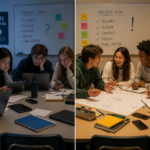
For many teachers, one of the most productive shifts they can make is moving from talking at students to talking with them. Instead of immediately providing answers, teachers can ask questions, invite opinions, and encourage students to think through problems together. By offering hints and guidance while allowing students to arrive at conclusions themselves, teachers create opportunities for deeper engagement.
When students are included in the process of building knowledge, something interesting begins to happen. They develop a sense of ownership over the classroom. The class no longer feels like something imposed on them but rather a space where they are active participants. As that sense of ownership grows, students often begin to regulate their own behavior and encourage their peers to stay focused. Research on student engagement suggests that this kind of active participation plays an important role in sustaining motivation and meaningful learning (Fredricks, Blumenfeld, & Paris, 2004).
For language teachers, this kind of interaction is not simply helpful. It is essential. Language develops through use, negotiation of meaning, and communication with others rather than through passive exposure alone (Long, 1996). In other words, students do not learn a language simply by hearing it explained. They learn it by trying to use it.
When classrooms begin to function this way, something else tends to happen as well. Classroom management becomes much less of a struggle. Students who feel involved in the learning process are far less likely to disengage from it.
And that brings us back to the original question.
What kind of teacher are you?
Are you the kind of teacher who focuses on delivering information, or the kind who creates the conditions where learning can actually happen?
Because once you begin to think about teaching in those terms, lesson planning changes. Activities change. Even the way you talk with students changes.
And sometimes, the classroom changes as well.
References
Fredricks, J. A., Blumenfeld, P. C., & Paris, A. H. (2004). School engagement: Potential of the concept, state of the evidence. Review of Educational Research, 74(1), 59–109.
Long, M. H. (1996). The role of the linguistic environment in second language acquisition. In W. C. Ritchie & T. K. Bhatia (Eds.), Handbook of second language acquisition (pp. 413–468). Academic Press.
Vygotsky, L. S. (1978). Mind in society: The development of higher psychological processes. Harvard University Press.
Weimer, M. (2013). Learner-centered teaching: Five key changes to practice (2nd ed.). Jossey-Bass.



Leave a Reply