
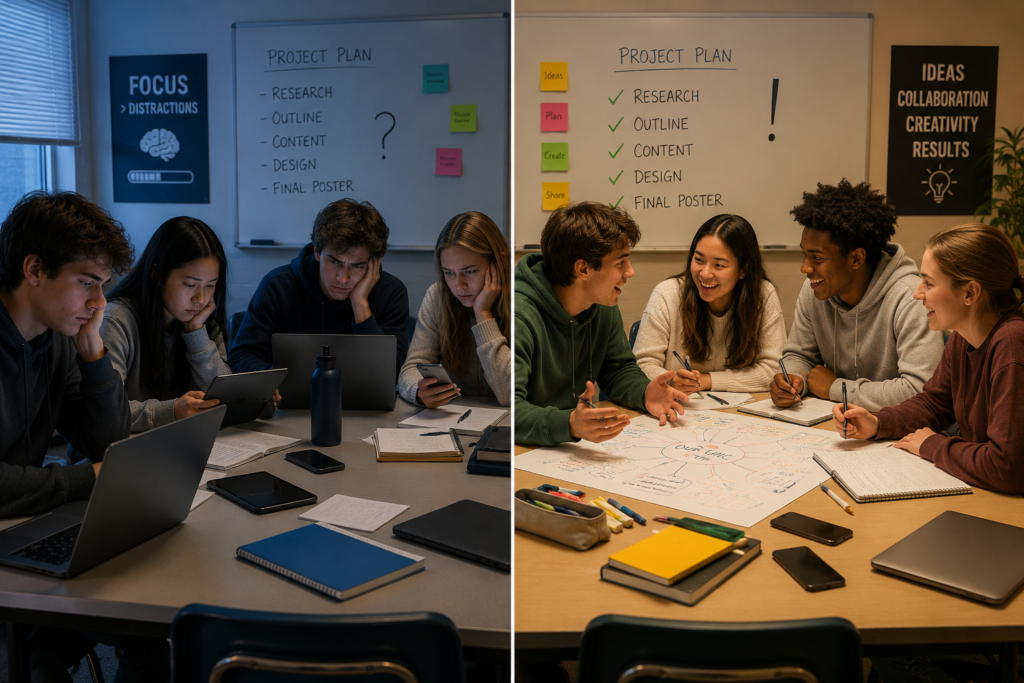
In this post, I want to explore the relationship between analogue and digital thinking and, more importantly, how we use analogue and digital processes in learning. This is not an argument that one is better than the other. Quite the opposite. I think our students need experience with both, along with an understanding that the best tool depends on what they are trying to accomplish.
Young people today have grown up surrounded by digital technology. Smartphones, search engines, online documents, social media, and now generative AI have made information almost instantly available. Ask a question and an answer is usually only a few taps away. Need directions? There is a map. Need to calculate something? There is a calculator. Need information for an assignment? Search engines can provide millions of possibilities.
This convenience is obviously useful. The question is what happens when convenience becomes our default way of thinking.
The Answer Is Always There
One thing I have noticed in my classes is a tendency to want the answer immediately. If students encounter a problem and cannot solve it quickly, they may look for an answer rather than spending time working through the problem themselves. In some ways, this is what I think of as Google thinking: ask the question, find the answer, move on.
This is understandable. We have created an environment in which information is expected to be available immediately. The issue is not that young people use Google, smartphones, or AI. These are incredibly useful tools. The question is what might be lost when we rarely have to work something out for ourselves.
I sometimes talk with my wife about how we may have been a particularly fortunate generation in this respect. We were born into an analogue world that gradually evolved into a digital one. We learned how to do things without technology before technology became the easiest option.
I learned how to read a paper map, find information using a book index, and calculate change without a calculator. More importantly, I learned that if I did not know something, I might have to spend some time figuring it out.
Of course, I use digital tools for all of these things now. I have no desire to return to paper maps and encyclopedias. What I value is not necessarily the ability to perform these tasks manually. It is the underlying understanding of how and why they work.
That distinction matters.
Sometimes the Screen Is Not the Best Place to Think
There is an argument that many analogue skills are no longer necessary. Why learn how to navigate with a map when your phone can tell you where to go? Why calculate something manually when a calculator can do it instantly? Why remember information when you can search for it?
There is some truth in this argument. We should not teach analogue skills simply because they are analogue. However, there is value in understanding how something works, even when technology can do it for us. There is also value in having an alternative when technology is unavailable, unreliable, or simply not the best tool for the task.
The same principle applies to learning.
When I ask a class to begin developing ideas for a project, I have often found that putting a blank sheet of paper in front of them can be more productive than putting them in front of a blank computer screen. A blank digital document can feel surprisingly intimidating. Students may stare at the cursor waiting for an idea to appear.
Paper changes the experience. They can draw, write in different places, connect ideas with arrows, cross things out, move ideas around, and create a mind map without worrying about formatting or presentation. They are also more likely to turn to the person sitting next to them and discuss their ideas.
The technology can come later.
There is some research support for considering the medium used for note-taking and processing information, although the evidence is more nuanced than the simple claim that handwriting is always better. A 2024 meta-analysis found an advantage for handwritten notes in achievement and review, while Voyer et al. (2022) found no overall significant advantage for one note-taking method over another. The research therefore does not support a simple “paper is better” conclusion. Instead, it reinforces the need to consider the task, the learner, and the learning environment (Flanigan et al., 2024; Voyer et al., 2022).
That is precisely why I prefer a hybrid approach.
From Analogue Thinking to Digital Production
One approach I have increasingly used is to deliberately combine analogue and digital processes. Rather than completing an entire project digitally, I divide the process so that different tools are used for different stages.
Consider a group poster project.
The process might look something like this:
1. Brainstorm and discuss: analogue
The group begins face to face. Members brainstorm ideas, discuss possibilities, and create a mind map. The goal is not to produce something polished. It is to explore possibilities and see the bigger picture.
2. Research: digital
Once they have some direction, they move online to conduct research. Digital tools are extremely useful here. They can search for information, compare sources, save useful material, and collaborate through shared documents. I also encourage the use of a reading spreadsheet where relevant source and citation information can be recorded. Here, copying and pasting accurate bibliographic information is entirely appropriate.
3. Note-taking: analogue first
Rather than immediately copying information into a digital document, group members take notes by hand. They can then transfer their notes to a shared online document. The goal is to process and summarize information before it enters the final workspace.
4. Organize and plan: face to face and digital
The group returns to face-to-face discussion to decide what information it actually needs. Members organize their ideas and develop an outline while using the shared document to keep track of their work.
5. Prepare the text: digital
The digital environment now becomes particularly useful. The group can draft, revise, edit, and collaborate on the written content. Because the document is shared, members can continue working according to their individual schedules.
6. Design the poster: analogue first
Before opening an info-graphic or design program, the group sketches the poster on paper. They decide where the major elements should go, what information deserves emphasis, and how the overall design should work.
7. Create the final product: digital
Only after the concept has been developed do they move into the digital design environment and create the final poster.
This might seem like adding unnecessary steps. In practice, I have found that it can make the process more efficient.
Why Not Just Start with a Template?
This is particularly noticeable when creating posters or info-graphics. Most online design platforms provide attractive templates, and these can be useful for showing learners what is possible.
The problem comes when they try to force their ideas into an existing template.
A template was designed for somebody else’ content, structure, and purpose. It can therefore encourage the creator to adapt the idea to the template rather than designing the communication around the idea.
This is why I prefer groups to sketch their poster on paper first. They can look at templates for inspiration and to discover what design elements are available, but the actual plan should begin with their own concept.
The paper version does not have to look good. It is simply a plan. Once the group knows what it wants to communicate, it can open a digital design tool and start with a blank canvas.
The digital tool then does what it does best: helping turn an idea into a polished final product.
This is what I mean by analogue thinking and digital production.
The Hidden Benefit: Better Group Work
There is another reason I like this hybrid approach. It can make group projects considerably more manageable.
One of the most common complaints I have heard about group projects is that members have to meet outside class. Another is that projects consume too much class time because groups spend entire lessons organizing themselves.
Neither is particularly efficient.
Face-to-face time is valuable, but it should be used for things that benefit from face-to-face interaction: brainstorming, discussion, negotiation, planning, and decision-making.
Once those decisions have been made, group members do not necessarily need to sit in the same room. A shared online document allows them to continue working according to their individual schedules. This is something the students I have worked with have often appreciated, even though they had not necessarily thought of using shared documents this way themselves.
The result is a genuine hybrid process. Limited class time can be used for focused discussion and collaboration, while digital tools allow the work to continue independently.
The analogue component also reduces the amount of time spent staring at a blank screen. Instead, the digital workspace already has a purpose and a plan.
Technology Is a Tool, Not the Process
This brings me back to one of the themes running through this series: technology should serve the learning process rather than become the learning process.
There is a temptation to think that if young people are using technology, we are automatically creating a modern learning environment. I do not think that is true.
A learner sitting alone in front of a laptop for two hours is not necessarily more engaged, creative, collaborative, or productive than someone sitting around a table with a sheet of paper.
The important question is what the learner is actually doing.
Are they generating ideas? Discussing possibilities? Making decisions? Evaluating information? Solving problems? Creating something? Reflecting on their choices?
Sometimes the best tool will be digital. Sometimes it will be paper and a pencil. Sometimes it will be another person.
The important thing is to make the choice deliberately.
This is particularly relevant when we talk about digital distraction. Martin et al. (2025), in a systematic review of research on digital distractions in education, identified technology-related factors as common causes of distraction and highlighted loss of attention, multitasking, and ineffective reading among the reported consequences. Importantly, the review also identified instructional and personal factors, suggesting that simply blaming the device misses part of the problem.
The answer, then, is not necessarily less technology. It is more intentional technology use.
Do Not Assume Digital Literacy
There is another issue that this approach can reveal. Teachers sometimes assume that young people are digitally literate simply because they use digital devices constantly.
Being comfortable with a smartphone is not the same thing as being digitally literate.
This is another reason I have become increasingly uncomfortable with the old idea of the digital native. Research has challenged the assumption that growing up with technology automatically produces advanced digital skills or fundamentally different approaches to learning (Eynon, 2020; Janschitz & Penker, 2022).
Someone may be perfectly comfortable navigating social media while having little experience with collaborative documents, file management, academic research, source evaluation, presentation software, or other technologies required for academic work.
Hybrid projects can provide a useful form of needs assessment. As learners work through a project, the teacher can see where digital scaffolding is required and where individuals are already independent.
I usually introduce several tools that I know and use, but I also give participants some freedom to explore. If the final product meets the requirements, I do not necessarily care which particular tool they used to create it.
That is part of developing genuine autonomy.
The teacher sets the standards and deadlines. The learners take some responsibility for deciding how they will reach those standards.
Finding the Balance
I am not advocating a return to a completely analogue classroom. Digital technology has transformed what learners can do, and much of that transformation is positive. We should take advantage of it.
What I am advocating is a more deliberate approach to technology.
Some things are better done digitally. Others may be better done by hand. Some tasks benefit from individual work, while others benefit from face-to-face discussion. Some stages of a project benefit from a shared online workspace, while others benefit from stepping away from the screen altogether.
In other words, learners need to develop the ability to choose the right tool for the cognitive task.
That may be one of the more important forms of digital literacy we can teach.
The goal is not to choose between digital and analogue. It is to develop a hybrid process in which each environment is used for what it does best.
Digital tools are excellent for searching, sharing, editing, communicating, and producing polished final products. Analogue processes can be excellent for brainstorming, sketching, planning, note-taking, and seeing ideas develop without the constraints of a digital interface. Sometimes, the best tool of all is another person sitting across the table.The challenge for teachers is to stop asking, How can I use technology in this activity? and start asking a more useful question:
What is the best environment for this particular stage of learning?
References
Eynon, R. (2020). The myth of the digital native: Why it persists and the harm it inflicts. In T. Burns & F. Gottschalk (Eds.), Education in the digital age: Healthy and happy children (pp. 99–111). OECD Publishing. https://doi.org/10.1787/1209166a-en
Flanigan, A. E., Wheeler, J., Colliot, T., Lu, J., & Kiewra, K. A. (2024). Typed versus handwritten lecture notes and college student achievement: A meta-analysis. Educational Psychology Review, 36, Article 78. https://doi.org/10.1007/s10648-024-09914-w
Janschitz, G., & Penker, M. (2022). How digital are ‘digital natives’ actually? Developing an instrument to measure the degree of digitalisation of university students – the DDS-Index. Bulletin of Sociological Methodology/Bulletin de Méthodologie Sociologique, 153(1), 127–159. https://doi.org/10.1177/07591063211061760
Martin, F., Long, S., Haywood, K., & Xie, K. (2025). Digital distractions in education: A systematic review of research on causes, consequences and prevention strategies. Educational Technology Research and Development, 73, 3423–3451. https://doi.org/10.1007/s11423-025-10550-6
Voyer, D., Ronis, S. T., & Byers, N. (2022). The effect of notetaking method on academic performance: A systematic review and meta-analysis. Contemporary Educational Psychology, 68, 102025. https://doi.org/10.1016/j.cedpsych.2021.102025



Leave a Reply